Sunday, 13 May 2012

My home is my castle


As part of the show we wanted to create some collaborative pieces that would really bound our work. The process has been very much a group effort and we wanted work to reflect this. We also thought it was crucial that the show was as interactive as possible whilst remaining a way to show case our work. I am impressed by galleries that strive for visitors across a wider range of society that just the “Art World” and this was an ambition of ours. Leeds Art Gallery has used simple but effective ways of engaging people by allowing space for discussion. I have always enjoyed using galleries and museums as creative spaces and so I created a drawing board as an extension of my cityscape.


We also invited our visitors to build their own space by providing a good old-fashioned box fort. There are few shared memories from people’s childhood fonder than building your own castle and that pleasure was still obvious in our visitors on our opening night. What started as a fairly light-hearted idea evolved into a catalyst for some significant discussions. Next door to our show, a local church was having an evening meal for homeless people of Leeds and a lot of our visitors came across from here. Suddenly a work that explored the idea of creating our own homes took on new poignancy when viewed with people whose main form of shelter was less than we had provided as a form of entertainment. It was a really amazing experience to talk to people whose experiences of Leeds were so different from my own and whose lives were so deeply entwined with the building we were occupying.


Home was also a feature of another group work, we created a space entitled “Do you see where I’m coming from?” where we asked our visitor to mark the place they felt had been or were still there homes. The rapidly filling maps of Leeds, the United Kingdom and the entire world created links between viewers and highlighted how small the world can be.


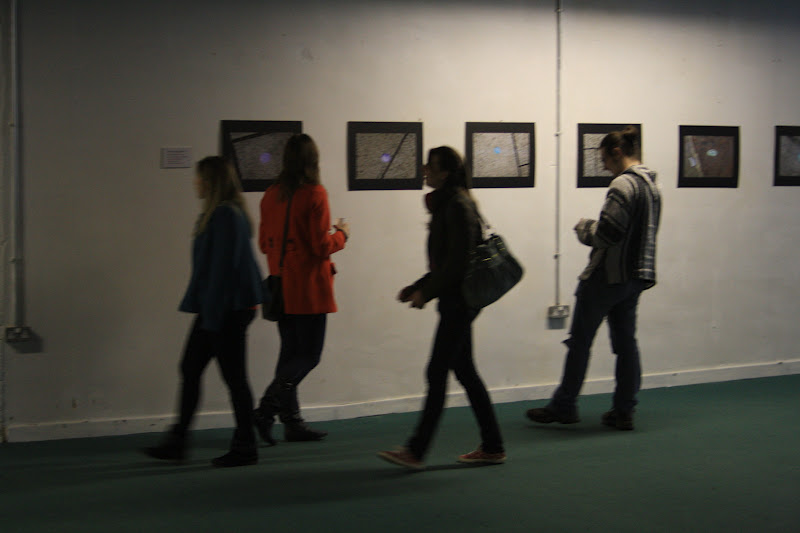
Our final work played upon the idea of regeneration of the Merrion centre, visitors could move around the show and find miniscule scenes of reconstruction and city life. Many of these light-hearted scenes used blemishes in the room that were scaled up to provide shelter for the tiny couples and meetings. We wanted to create a purely fun representation of life for the show and these mini scenes became a way of encouraging movement around the space. We were so pleased with this collaboration that we chose it to figure-head our exhibition posters.


The group works exploration of home has a lot in common with my work as I am interested in the idea of what makes a place a home. The maps ask people that questions and the answer is sometimes hard to place geographically. The formation of a home within the space followed the same thought and questioned how we make the space that becomes important enough to be painted, photographed or drawn onto a map.

Our Work.


Our work
I was eager to make a piece that was a positive representation of Leeds. The space that we were exhibiting in is going to be regenerated in the next year and I want to celebrate the cities changing landscape. I enjoy the old architecture of Leeds but I think the beauty of Leeds is the interaction between old buildings and new designs. I chose to work with the question “if Leeds was one road, what would be on your road?”
The buildings I chose were my home; the buildings on the Hyde Park corner; the Parkinson Building; my first home in Leeds; the Blackwell’s university bookshop; the Merrion centre (where our exhibition is being held) and the Corn Exchange.
Alongside my work I made a drawing board and invited people to draw either their home or their favourite building.
My hope is that people will enjoy my work and have fun thinking about their version of Leeds. I think that we each have a different city as our home even when we live in the same place. Our experiences shape that home and make our city personal to us.


When we first decided to collaborate, the five artists in the show all decided to work with the common theme of Regeneration and Leeds. Our work varies in mediums and we usually work with very different concepts so we decided that by working towards a common theme our exhibition would be more successful.
We were really keen to create a welcoming space and move away from the idea of a high art and somewhat unapproachable gallery spaces we have experienced. My work has a lot in common with Decca Mclaughlin who created tiny art works on chewing gum in the streets. We both were eager to make art from the everyday surroundings.  I hope that my work encourages the viewers to take in the beauty of the city and appreciate previously unseen features of the city. Decca’s work makes an ugly aspect of the streets into some appealing and worthy of being sought out.


Likewise, Katie Iveson’s work aims to celebrate Leeds although her more work is more specific to the venue we have shown in. Her works take the form of collage that is minimalist and geometric as well architectural style drawings. Although my work is more painterly I have also used photography to create collage and we have both played with the idea of manipulating photography to make our own, new images.


Ella Sergeant and Ali Noble have both explored the idea of space in a more abstract manner Ella has used series of automatic drawing machines that ‘tickle’ iron filings into intricate patterns. She has a described her desire to entice people to look into the small undiscovered places – a common them in our work.


 Ali has used the space to create textile pieces and paper cut outs that mirror popular culture posters from the home and, the case of the largest piece is reminiscent of a wall in a home complete with windows. The work divides the space and a domestic scene comes to mind through the use of found materials.


Our main desire was to raise the profile of undiscovered gems. Leeds is a beautiful and vibrant city and should be celebrated.